Amber and Order: What Hong Kong's Herb Shops Taught Me About Wearing Texture

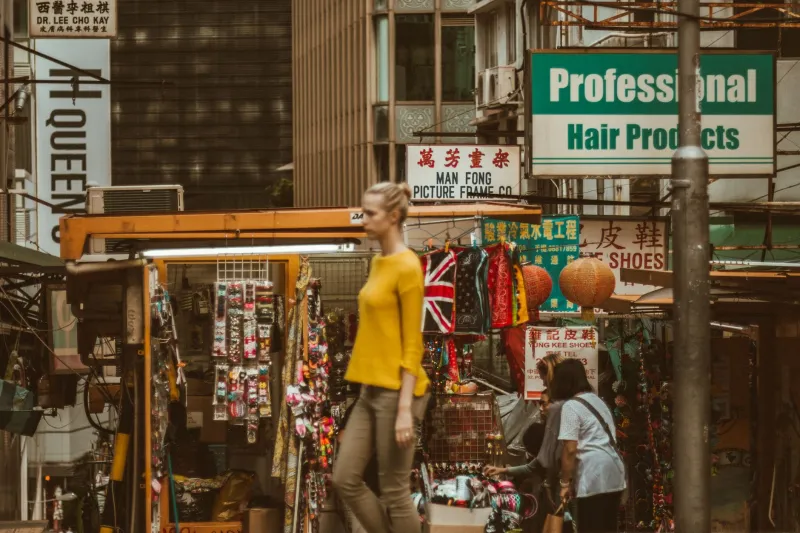
Photo: К.Артём.1, CC BY-SA 4.0, via Wikimedia Commons
There's a shop on a side street in Sheung Wan with a wall of drawers running floor to ceiling and a smell that hits you at the door — dried orange peel, something like licorice, something older and earthier underneath.
It's a traditional Chinese medicine shop. The drawers hold herbs. The counters hold brass scales, glass jars, and scoops. There's a paper ledger, a worn stool, and not a single decorative object in the entire room.
It is also, and I mean this seriously, one of the best-dressed spaces in the city.
Everything Has a Label and Nothing Is Loud
Walk that wall with your eyes and you notice a system. Hundreds of small wooden drawers, each with a brushed label in a consistent hand. The grid is dense but never chaotic, because the variation is controlled: same wood, same label size, same drawer front.
That's restraint doing structural work. The shop isn't minimal in the Scandinavian sense — it's packed — but every object earns its place by doing a job. Nothing is there purely to be looked at.
Geek wardrobes tend to swing the other way. We collect: a graphic tee, a pin set, a lanyard, a chain, a beanie with a character on it. Each piece is a fine choice alone; together they cancel each other out. The apothecary wall suggests another approach — density plus discipline.
Texture Does the Work That Pattern Usually Does
The visual interest in these shops comes almost entirely from materials. Raw wood, unglazed ceramic, amber glass, brass fittings, folded paper packets, fabric sacks. Surfaces that catch light in different ways as you move past them.
Translate that to clothing and you get a rule worth taping to your mirror: when you aren't wearing pattern, wear texture.
Three textures per outfit is plenty. A slub cotton tee, a raw linen overshirt, and a brushed flannel or waxed canvas layer gives you variation without a single print. Add suede or nubuck shoes and you're done.
The trap is texture overload — everything nubby and rustic at once, which starts to read as costume rather than choice. Keep at least one smooth element in the mix: denim, a clean cotton poplin, a plain leather belt.
The Herb Palette Is a Real Palette
Look at what's actually in those jars and you get a full color story: dried orange peel, cuttlefish bone, licorice brown, goji berry red, chrysanthemum pale, deep green leaf, and amber glass filtering all of it into a warm glow.
That's a muted, earthy range with one saturated accent. It's wearable, it flatters most skin tones, and it's nowhere near the grey-and-black default a lot of geek closets fall into.
In practice: bone, oat, and sand as the base; tobacco, rust, and olive through the middle; a single saturated red or deep green as punctuation. Amber glass is the accent — the thing that catches the eye without shouting for attention.
Amber, Brass, and the Two-Point Rule
The most transferable idea in the whole shop is the amber bottle. Brown glass with a brass cap is a small warm object that reads as considered rather than decorative.
Wear the equivalent. Amber-tinted sunglasses. Tortoiseshell frames. A brass zipper pull on a jacket. Horn buttons on a shirt. A brown leather watch strap with brass hardware. A single brass pin on a canvas tote.
Cap it at two. Two small warm-metal or amber objects per outfit. Three and it becomes a theme; one and it disappears.
The Costume Cliff
This is where the look goes wrong. The apothecary aesthetic tips into costume the moment the silhouette turns period. A linen tunic, a mandarin collar, a satchel, and round wire glasses worn together is a character, not an outfit.
Stay modern in cut. Straight-leg or relaxed trousers, a clean crewneck, a boxy overshirt, a simple sneaker. Let the materials and palette carry the reference. If someone can identify the inspiration without you explaining it, you've gone a step too far; if they just think you look good, you've landed it.
A Starter Move for This Week
Pick one thing. Swap a black tee for an oat or bone one in a heavier slub cotton. Add a brown leather belt with a brass buckle. Put amber lenses in your everyday glasses. That's the whole assignment — one warm object against a neutral base.
Then notice how often people ask where something is from. That question is the entire game, and it's won with restraint, not volume.