Perfectly Wrong: Why Hong Kong's Bootleg Tees Are the Most Honest Thing in Geek Fashion Right Now
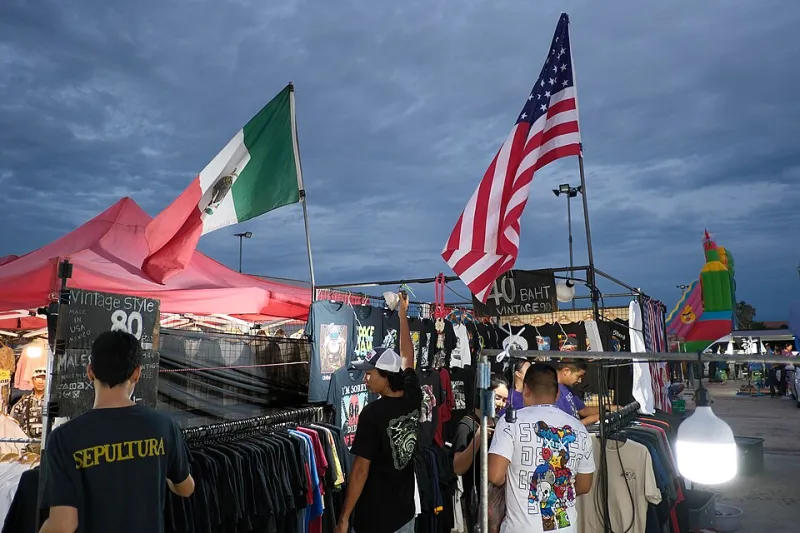
Photo: PattayaPatrol, CC BY-SA 4.0, via Wikimedia Commons
There's a stall in Mong Kok — you've probably walked past it, or seen it in someone's travel reel — where the tees are stacked three feet high and the prints are gloriously, unapologetically off. The Iron Maiden logo bleeds slightly to the left. The Evangelion Unit-01 is the right color but the wrong pose. The Metallica lettering is just a touch too wide, like it got stretched in the wash before it even left the press. These aren't mistakes so much as signatures. And right now, a growing slice of American geek culture is absolutely obsessed with them.
Welcome to the world of the Hong Kong bootleg tee — and the surprisingly rich fashion philosophy hiding inside it.
The Market That Doesn't Care About Licensing
Hong Kong's street markets have always operated on a different frequency than the official retail world. Places like Sham Shui Po and the labyrinthine stalls of Ladies' Market aren't exactly worried about trademark registration. What they've produced over decades is a parallel universe of merchandise — one where Naruto's eyes are slightly too far apart, where a vintage-style AC/DC tee uses a font that's almost right, where the distressing on a Dragon Ball graphic looks like it aged twenty years in a single afternoon.
For a long time, Western consumers — especially geek consumers — treated this stuff as a punchline. The "knockoff" was something to laugh at on Reddit, not something to wear with intention. But that attitude is shifting, and it's shifting fast.
Part of what's driving the change is a broader exhaustion with the whole authenticity industrial complex. Official band merch now sells for $55 at a stadium stand. A licensed anime collab hoodie from a hypebeast brand can run you $200. The "real" stuff has gotten so expensive and so carefully managed that it's started to feel sterile. Meanwhile, the bootleg tee from a Hong Kong market stall has something the official version doesn't: actual personality.
The Glitch Is the Point
In geek culture, there's a long tradition of loving the artifact — the misprint, the variant, the error card. Pokémon players have been paying premiums for miscut cards for years. Retro game collectors hunt specifically for prototype cartridges that glitch in interesting ways. The idea that a flaw makes something more valuable, not less, is already baked into the DNA of how a lot of American geeks relate to the things they love.
Bootleg tees slot right into that logic. When a Hong Kong screen printer slightly mistranslates a kanji phrase on a Demon Slayer shirt, or when the registration on a classic rock tee is just enough off to create a shadow-print ghost effect, that's not a quality control failure — that's a one-of-a-kind artifact. You can't get that at Hot Topic. You can't order it on Amazon. The imperfection is, functionally, a limited edition.
US geeks who've started hunting these pieces — through Hong Kong-based sellers on Depop and Carousell, through Reddit communities dedicated to "interesting" bootlegs, through friends who bring them back as souvenirs — talk about them the way record collectors talk about pressings with label errors. There's a hunt to it. There's a story.
DIY Culture's Unlikely Muse
Here's where it gets really interesting for the American streetwear scene specifically: the Hong Kong bootleg aesthetic is actively inspiring a new wave of DIY customization stateside. People are intentionally recreating that slightly-off look — bleaching tees unevenly, printing their own iron-on graphics with deliberately low-res source images, using off-brand transfers that bleed at the edges.
The goal isn't to fake a bootleg. It's to capture the energy of one. That sense that this piece wasn't produced by a committee in a licensing meeting, that it came from somewhere messier and more human. The Hong Kong market stall operator who ran off 200 Gundamn tees (yes, with an extra N) at 2 a.m. was not thinking about brand consistency. And somehow that comes through in the fabric.
Custom tee communities on TikTok and Instagram are full of creators explicitly citing this influence. The "wrong print" aesthetic has its own hashtag ecosystem now. People are proud of the misspelling. They're leaning into the bleed. One creator in Portland has built a following entirely around what she calls "intentional bootleg energy" — screen printing her own anime and band graphics with techniques borrowed from the deliberately rough output of Southeast Asian market vendors.
Authenticity Is Overrated, Actually
There's a philosophical thread running through all of this that's worth pulling on. For a long time, geek fashion culture in the US was obsessed with legitimacy. Was your tee officially licensed? Was your figure a first-print? Was your patch from the actual tour? The gatekeeping around "real" versus "fake" merch was intense, and it was tied up in a whole set of values about what it meant to be a true fan.
But that framework is cracking. Younger fans, especially those who've grown up in an era of infinite digital reproduction, are less attached to the idea that official equals authentic. What matters more is whether something feels genuine — whether it carries a story, whether it has texture, whether wearing it says something specific about who you are rather than just signaling that you could afford the licensed version.
Hong Kong's bootleg market culture, which has always operated with a cheerful indifference to those official hierarchies, turns out to be a pretty good philosophical model for that shift. The vendors in Sham Shui Po weren't making a statement about intellectual property law. They were just making stuff people wanted, fast and cheap and with a certain wild energy. But the result — those gloriously imperfect tees — embodies something that a lot of American geeks are now actively chasing.
How to Wear It Without Making It Weird
If you're curious about incorporating this aesthetic into your own fits, the good news is that it's pretty low-stakes. A few things to keep in mind:
Source with intention. If you're buying actual Hong Kong bootlegs through resellers, look for pieces where the "wrongness" is interesting rather than just sloppy. A great bootleg has character. A bad one just looks unfinished.
DIY is valid. Recreating the aesthetic yourself — through intentional low-fi printing, distressing, or graphic manipulation — is completely in the spirit of the thing. This isn't about owning a specific artifact. It's about embodying an attitude.
Style it straight. The bootleg tee works best when you're not winking too hard at the camera. Wear it tucked into clean trousers or under a structured jacket. Let the tee do the talking without making the whole outfit a joke. The contrast between the rough print and the polished styling is where the magic lives.
Embrace the conversation. Half the fun of a great bootleg tee is the moment when someone notices the misspelling or the off-register print and asks about it. That's your story. Tell it.
The Wrong Tee for the Right Reasons
Hong Kong's street markets have been producing these beautiful mistakes for decades, mostly unnoticed by the American fashion conversation. But the timing is finally right for a wider audience to catch up. In a moment when geek culture is interrogating its own gatekeeping instincts, when DIY is having a genuine renaissance, and when the most interesting streetwear is the stuff that can't be easily categorized — the imperfect bootleg tee from a Kowloon market stall might just be the most honest piece of clothing you own.
Wear it wrong. Wear it proud.